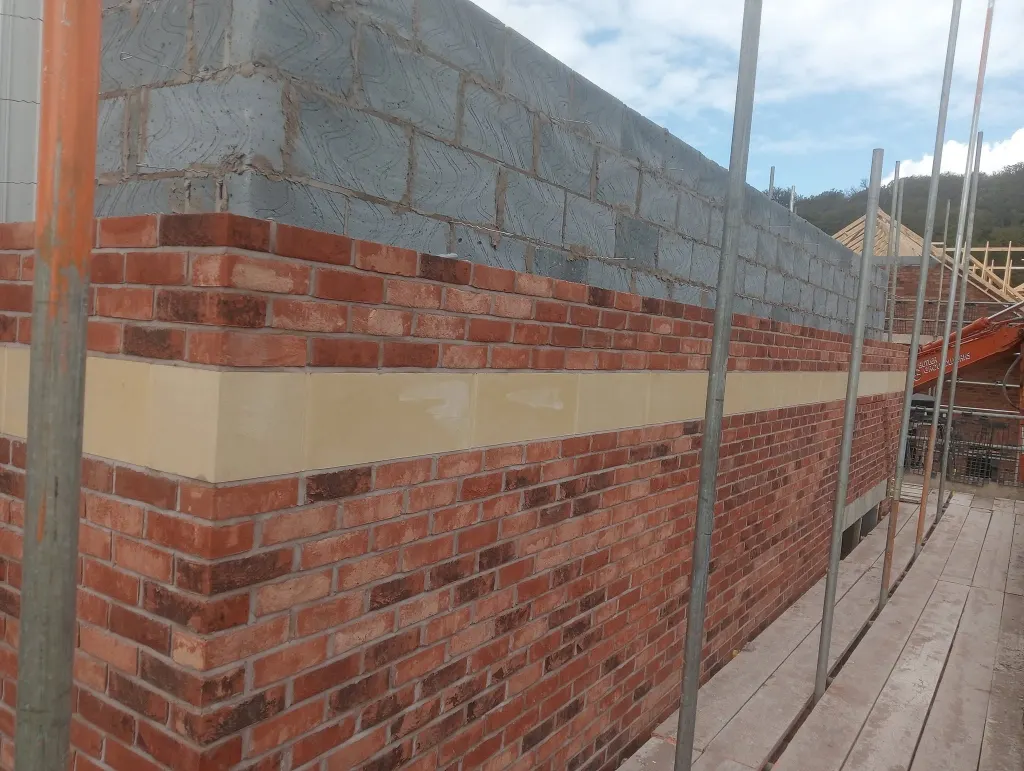
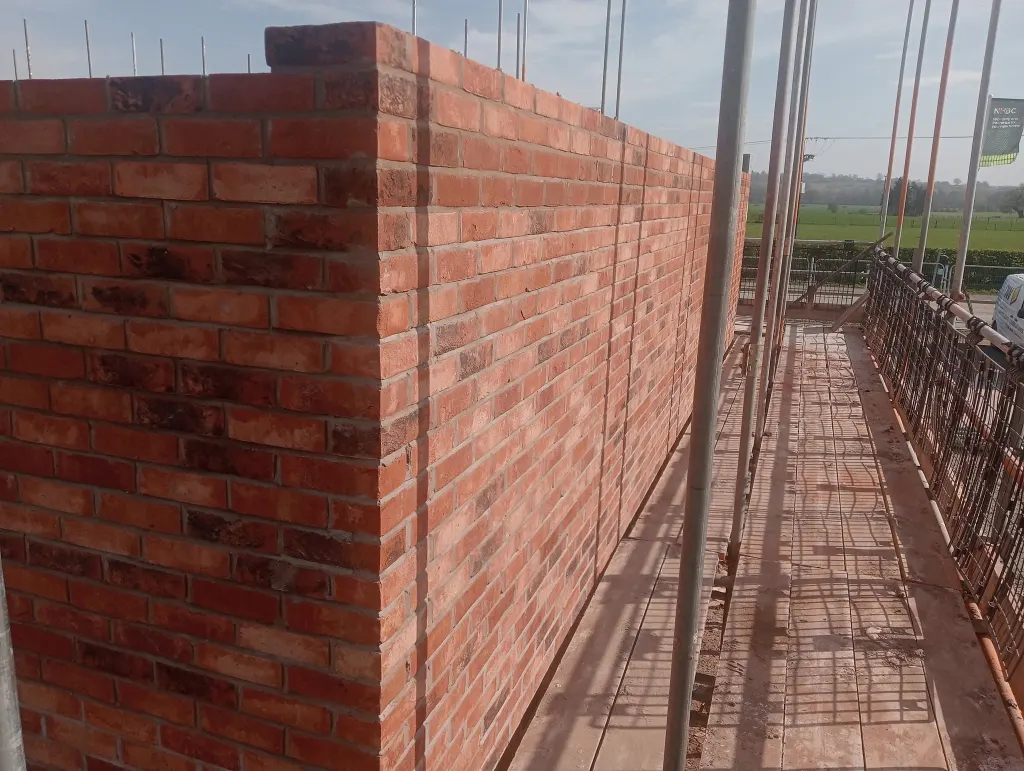
Facing brickwork on a phased development stays consistent when bricks are blended from several packs, deliveries are controlled by batch, a sample panel sets the standard, and mortar and joints are kept the same throughout. KW Brickwork Contractors Ltd, a bricklaying contractor based in Welshpool, Powys, explains how we approach it on housing sites across Mid Wales, Shropshire and the West Midlands.
Facing bricks are made from natural clay, fired in kilns, and their colour varies. That variation is part of their appeal, but it also means two deliveries of the "same" brick can look noticeably different. On a development built over months or years, colour banding between plots, or even between lifts on the same house, is one of the most common complaints about new-build brickwork. And it can't be fixed without taking the wall down.
Blending: mixing from several packs
The first rule is simple. Don't build from one pack at a time.
- The NHBC Standards say that, unless bricks have been blended by the manufacturer, bricks from different batches should be mixed to avoid colour patching.
- The Brick Development Association's guidance on blending brickwork recommends drawing bricks from at least three packs at the same time, with some overlap between batches or deliveries.
In practice, that means opening several packs at once and loading out from all of them, so every section of wall gets a mix. Taking bricks down the face of the pack rather than layer by layer from the top helps too. Some packs are layered in a way that concentrates colour. When one pack runs out, the next is opened while the others are still in use, so the transition is gradual.
On a busy site, whoever loads out the scaffold decides whether this happens. It has to be part of the gang's routine, not an afterthought.
Batch control and deliveries
Blending evens out variation within a batch and between neighbouring batches. It can't hide a big jump between two very different deliveries. On a phased development that's where most problems start.
Things that help:
- Order ahead. Where the budget and storage allow, order enough brick for a phase, or at least for whole blocks of plots, from as few production batches as possible.
- Record batch numbers. Keep a note of which batches went on which plots. If a later delivery looks different, you can see how far it's likely to show.
- Check deliveries on arrival. Open a pack and compare it with bricks already built, in daylight, before it goes up on the scaffold. A delivery that looks noticeably different should be raised with the site manager and supplier before it's used, not after a lift has been built.
- Don't split phases across very different stock. If a change of batch is unavoidable, try to make it at a natural break, such as a new block of plots or a change of house type, rather than halfway up a terrace.
The sample panel
Many specifications call for a sample panel: a section of wall built at the start of the job, with the chosen brick, mortar and joint profile, and approved by the client or architect. It becomes the reference for the whole development.
A good sample panel is built from a proper blend of packs, is kept on site and protected for the life of the job, and is used. When a delivery arrives or a new gang starts, compare their work with the panel. On a long phased development, a panel that has weathered alongside the houses is a better guide than a photo.
Mortar is half the wall
Brick colour gets the attention, but mortar makes up a surprisingly large part of the face of a wall, and inconsistent mortar is just as visible as inconsistent brick.
- Keep the mix consistent. Use the same sand, cement and pigment (where used), measured the same way every time. Factory-produced or silo mortar gives very consistent results. Site-mixed mortar needs careful batching.
- Don't re-temper mortar that has started to set. It changes both strength and colour.
- Keep joint thickness even. Thick joints make a wall look lighter or darker, depending on mortar colour, and make the brick look smaller.
- Keep the joint profile the same. A bucket-handle joint and a weather-struck joint look very different in raking light. Agree the profile at the start and stick to it across every plot and every gang.
- Tool joints at the right time. Joints tooled when the mortar is too wet or too dry come out a different colour and texture.
Workmanship that affects appearance
Some things that look like brick problems are actually workmanship problems:
- Mortar smears and snots on the face darken the brick and are hard to clean off without damaging it.
- Rain on new work washes lime and fines out of fresh joints and can streak and stain the face. Covering wall heads at the end of each day protects the look of the wall as well as its strength.
- Saturated bricks can lead to efflorescence, the white salt deposits that come through as the wall dries. Keep packs covered and off the ground.
- Aggressive cleaning with the wrong products can permanently change the colour of some bricks. Follow the manufacturer's advice.
Stone banding and features
Many of the house types we build have buff stone or reconstituted stone bands, heads and sills. These add their own consistency challenge: the band has to run at the same course height on every plot, and neighbouring houses have to line through where they meet, as on a semi-detached pair. Getting the setting out right from DPC is what makes that possible. It can't be corrected halfway up.
Matching existing brickwork
The same principles apply to extensions and repairs, but in reverse. Instead of keeping new bricks consistent with each other, you're matching new bricks to old ones that have weathered. That means choosing the closest available brick, and sometimes reclaimed bricks, matching mortar colour and joint profile, and continuing the existing bond. Kris's NVQ Level 3 includes a unit on repairing and maintaining masonry that specifically covers matching existing materials and continuing existing bonding.
Summary
- Blend from several packs. The NHBC Standards expect batches to be mixed, and Brick Development Association guidance recommends at least three packs at once.
- Control batches: order ahead, record batch numbers, check deliveries against built work.
- Build and use a sample panel.
- Keep mortar mix, joint thickness and joint profile consistent.
- Protect new work from rain and keep materials covered.
- Set out stone details from DPC so they line through.
If you're planning a phased development and want a new-build housing brickwork contractor who takes consistency seriously, or need an extension or repair matched to existing brickwork, send Kris the details.